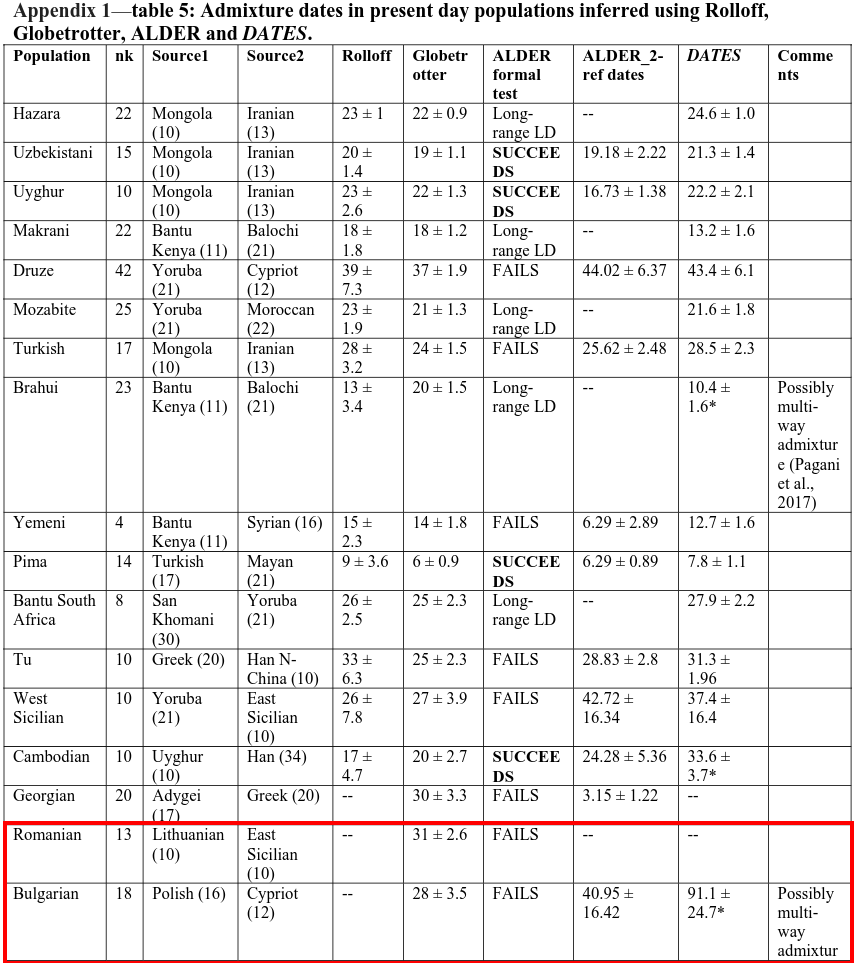
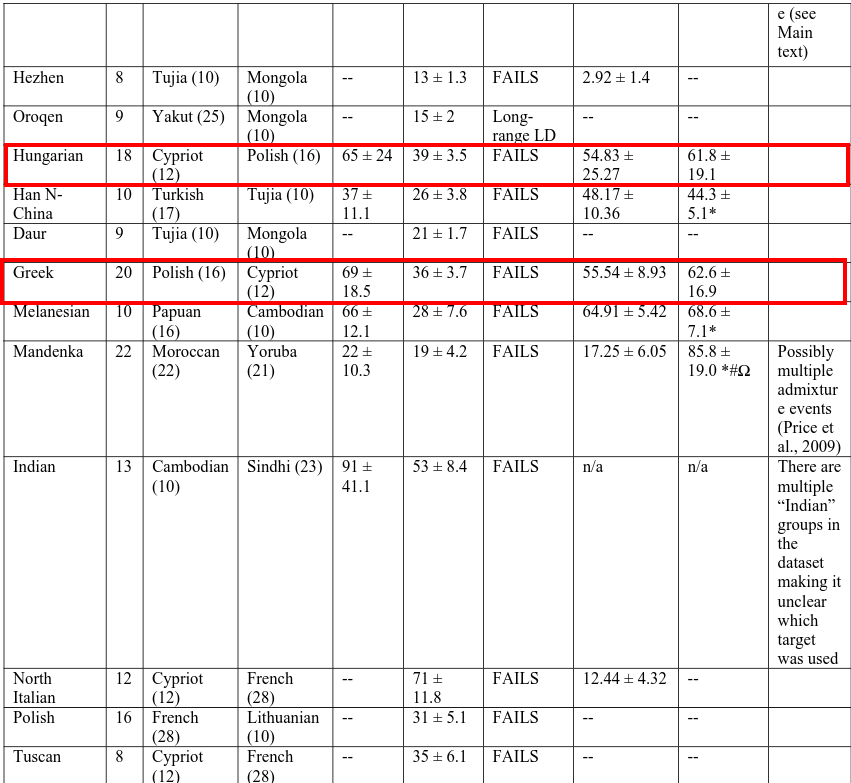
Публикацията е тук.Кухулин 2.0 написа: ↑18 Окт 2023, 00:07Ясно.avtohton.org написа: ↑17 Окт 2023, 23:30 Едно изчисление на 3 популации с DATES отнема към 10 минути на моя лаптоп, не ми се занимава с още много такива.
Ако си разучил по-дълбоко тази технология, имам питане: могат ли да се разраничават две и повече смесвания във времето? Да приемем две вливания на една и съща популация в българите, примерно 500 г. и 1000 г. В диаграмата с дължината на сегментите трябва да се образува някаква вълна, вероятно с два пика. Това би трябвало да се хваща статистически. Доколкото знам, DATES ползва разлагане по Фурие, тъй че принципно може да има такава възможност. От друга страна, ако просто търси корелация, вероятно в този сценарий ще даде някаква усреднена датировка 750 г. Тествал ли си такива неща?
Пишат:
DATES assumes a model of instantaneous gene flow with a single pulse of mixture between two source populations. However, many human populations have a history of multiple pulses of gene flow. To test the performance of DATES for multi-way admixture events, we generated admixed individuals with ancestry from three sources (East Asians, Africans, and Europeans) where the gene flow occurred at two distinct time points (Appendix 2—figure 1). By applying DATES with pairs of reference populations at a time and fitting a single exponential to the ancestry covariance patterns, we observed that DATES recovered both admixture times in case of equal ancestry proportion from the three ancestral groups when the associated reference groups were used for dating (Appendix 2—figure 2). In the case of unequal admixture proportions from three ancestral groups, DATES inferred the timing of the recent admixture event in most cases, though some confounding was observed, especially when the ancestry proportion of the recent event was low (Appendix 2—figure 3). However, if the reference populations were set up to match the model of gene flow, we observed that we could reliably recover the time of the recent gene flow event. For example, there is limited confounding if the two references used in DATES include: (i) the source population for the recent event and (ii) both ancestral populations that contributed to the first event or the intermediate admixed group formed after the first event (Appendix 2—table 1). This highlights how the choice of reference populations can help to tune the method to infer the timing of specific admixture events reliably.
Finally, we explored the impact of more complex demographic events, including continuous admixture and founder events using coalescent simulations (Appendix 2). In the case of continuous admixture, DATES inferred an intermediate timing between the start and the end of the gene flow period, similar to other methods like ALDER and Globetrotter (Hellenthal et al., 2014; Loh et al., 2013) (Appendix 2—table 2). In the case of populations with founder events, we inferred unbiased dates of admixture in most cases except when the founder event was extreme (Ne ~ 10) or the population had maintained a low population size (Ne < 100) until the present (i.e., no recovery bottleneck) (Appendix 2—figure 4, Appendix 2—table3). In humans, few populations have such extreme founder events, and thus, in most other cases, our inferred admixture dates should be robust to founder events (Tournebize et al., 2020). We note that while DATES is not a formal test of admixture, in simulations, we find that in the absence of gene flow, the method does not infer significant dates of admixture even when the target has a complex demographic history (Appendix 2—figure 6, Appendix 2—figure 7).